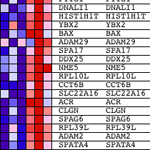
使用基因集富集分析的途径分析 (GSEA) 工具

基因集富集分析的许多方法之一 分析基因表达 描述文件数据,并在所述 工人在Broad研究院.

提示通过观察,学习的基本概念 单个基因 显示两种状态之间或表型表达水平最显着的差异是 缺乏机械洞察力. 代替, 采取更有意义 基因组 分享一些 生物链接, 问的问题 - 不显示任何统计学整套 显着富集 在那些有差异表达的基因?

基因组 可以选择, 先验, 一些原因,例如. 由以上的影响已知的基因集- 或根据一个微RNA的表达, 或者所选择的一组的基础上的染色体位置, 或基因的分子功能, 细胞成分和 / 或生物过程已分配使用的受控词表 基因本体论.

GSEA方法的优点之一是,它是可以掺入的 完整的数据集, 不只是那些成绩单和一个任意选定的差异表达门槛. 我敢肯定,很多人阅读本思考 - “这怎么可能确定使用完整的数据集? 通常情况下,我只会考虑基因 >2 (或其他喜爱的价值)-倍差异表达。“原因的方法是有效的,是在较低水平或复制较大差异表达的基因不利于GSEA使用的主要指标, '富集得分“ (ES).

GSEA第一 排行 每个基因的表达值 信号噪声 比例 - 计算代表每个表型的样品的平均值之间的差异和缩放它们的标准偏差的总和. 这意味着,基因表达水平差异较大的不同状态之间和生物之间的变化不大复制的排名高度.

下一个步骤是对ES, GSEA所产生的主要统计数据, 计算每个基因的集 - GSEA手册, 出色记录软件, 它指出:

“所有基因的信号噪声比排名第一, 然后在ES的计算方法是“走”下来的排名列表基因 增加运行总和 统计时,一个基因的基因组中,并 减少 它时,它不是. 该 大小 的增量取决于 相关 与基因 . ES是从零走在列表中遇到的最大偏差. 一 积极 ES表明基因组富集 顶部 位列榜单; 一 ES表明基因组富集 底部 位列榜单。“

ES值 基于基因组的大小,然后一个 错误发现率 计算, 误报的概率的估计. GSEA使用一个非常宽松的默认值 25%, 这是适于生成假设有相对大量的生物复制.

数据科学家 non-human 样品仍然可以使用GSEA, 但需要提防 - 在 基因符号 使用GSEA“翻译“从他们的人力等值i.e. 标识符用于物种基因芯片为代表的利息转换成他们的符号 人类同源基因, 然后在分析中使用. Subramanian和他的同事们 声称 这种转换具有很少或 没有效果 GSEA的效用; 它已成功地用于在多个非人类物种, 但当然,这必须牢记的详细调查结果时,.

对于一个优秀的, 在深入, 审查通路工具, 请教:

卡特里, P., 希洛塔, M., & 小山, 一. Ĵ. (2012). 十年的途径分析: 目前的方法和杰出的挑战. PLoS计算生物学, 8(2), e1002375. 二:10.1371/journal.pcbi.1002375

另一个很好的来源途径分析建议, 尤其是那些熟悉的R统计软件包 这里.

延伸阅读

萨勃拉曼尼亚à, 塔马约P, Mootha VK, 慕克吉小号, 艾伯特BL, 吉列MA, Paulovichà, 波默罗伊SL, 戈卢布TR, 兰德ES, Mesirov J​​P (2005) 基因集富集分析: 以知识为基础的方法,解释全基因组表达谱. PROC Natl科学院学报üS A 102:15545-15550

谢兴, 吕江宁, 退纸Kulbokas器, 戈卢布TR, Mootha V, 琳达巴德托博士K表, 兰德ES, 金匙中号 (2005) 系统发现在人类推动者和监管图案 3[黄金] 通过比较几种哺乳动物的非编码区. 性质 434:338-345

Posted in 路径分析 | 1 Response

编辑学术书籍的乐趣

Image courtesy of ningmilo / FreeDigitalPhotos.net

Or: “A beginner’s guide to herding cats”.

Consider this scenario: you are an academic scientist, in a busy research institute and your boss is invited to edit a book, but declines due to pressure of work; then suggests that it would look good on your CV. You agree, it would look good on your CV, so you commit yourself to editing your first multi-author academic science book.

So why is that a problem?

Getting authors on board

You want the best people to write the chapters. You Google some big-name experts and invite them to contribute a chapter to your book. They almost all decline, or fail to reply to your email. But, somewhat to your amazement, one agrees. However, this paragon of science then never, ever replies to any future contacts. So, you lower your sights and aim for good scientists, but not Nobel Prize winners. 最后, you get enough authors together to write the chapters around the topic that the publishers have given you – phew!

Getting authors to agree a deadline

Assuming it’s not unreasonable, everyone is usually relaxed about the deadline set. However, the real challenge is:

Getting them to meet the deadline

  1. This should be easy, right? Scientists are grown-up, professional people. Aren’t they? 好, sort of. In reality, academics typically over-commit themselves, doing not only research and teaching, but also writing grant funding applications, papers, reviews, book chapters, etc, etc. After all, the scientific mission statement is “publish OR be damned.”
  2. As the deadlines go past – “wooshh”, like passing cars, half your authors have submitted their chapters, the rest not. Now another sticky moment arrives – these are meant to be cutting edge reviews. State-of-the-Art. But this delay now means that the ‘good’ authors work is rapidly reaching its sell-by date. You may have to go crawling back to them to ask for updates. Which they are usually not too unhappy about, but you hate the loss of face.
  3. One more thing that I forgot to mention; as the editor, you have to READ these chapters. Worse still, you are expected to produce cogent critiques – what the author needs to add, remove, expand or contract. Even if the topic is on the fringe of your main expertise.

What happens if authors go AWOL?

What do you do when one of your authors decides that they are NOT going to write their chapter? Not simply procrastinate, fail to meet deadlines, but stop all communication. Disappear off the map. So, now you’re stuck – find another author(s) – more delay – write the chapter yourself? – but it’s too far outside your own area of expertise. So, eventually, you find someone else. Which means yet more delay.

Writing your own chapter

Oh, yes, you forgot that you agreed to write one of the chapters yourself. Oops. Oh well, not a problem. Offer co-authorship to one of your PhD students – they’ll be falling over themselves to get another publication on their CV. Or maybe not: no, they are not interested after all; obviously suspecting (correctly) that your aim is to let them write the whole thing, then submit the chapter to you for a little light editorial polishing.

Pleading with the publishers for more time

  1. You now hold the dubious record for the longest gestation period of a multi-author academic book in human history, excluding the Bible.
  2. ‘Please, sir, I want some more.’
  3. The publishers are not impressed, but quietly resigned, telling you to go away and come back when you meet a new deadline.

Losing your marbles and giving up completely

It’s all taking SO LONG – too few authors have submitted first drafts of their chapters. You start to get desperate – the original deadline was so long ago that you’ve forgotten it – the “new” deadline is also now history. You consider giving the whole thing up – apologise to the authors and the publishers and say the book can’t be finished. But your co-editor and the authors who have delivered on time are indignant – naturally enough they don’t want to see their work wasted – and insist that you go back to the recalcitrant scientists with a big stick. How do you threaten authors with a stick by email? Or by phone? However, a combination of the metaphorical big stick, pleas for mercy and piling on the guilt eventually work and all the chapters are delivered! Hooray.

Hooray!

So, now, you’re on the last lap. Or the last dregs – the soul-destroying process of assembling the index and proofreading. Once, a sub-editor with a scientific background might have written an index, but not now. Academic publishers want their pound of flesh, so this task is delegated to authors and editors. Authors select keywords from their chapters, with varying degrees of enthusiasm or accuracy, then the editor attempts to assemble them into something useful to the reader. 最后, a draft proof arrives by email. You are now heartily sick of every word, but a final spurt of enthusiasm drives you on and the book is finished.

One more thing – did I forget? – you don’t get paid – but you are given a few free copies of your own book. Such fun!

 

Posted in 浅浮雕 | 1 Response

如何定义一个转录因子引起胶耳中的突变?

Acute otitis media, sometimes known as “glue ear”, is the most common bacterial infection in children and by 1 year of age about 60% of children will have had one episode. In some cases, children develop a chronic condition, which, despite the infection being cured, 在 “glue” doesn’t go away and causes deafness.  In an inherited mouse model of chronic glue ear the causative mutation has been shown to be in a gene encoding a 转录因子, Evi1.

The EVI1 protein has multiple domains, can repress or enhance expression of target genes and interact with many other proteins. Indeed, the multiplicity of known and potential interactions is a challenge to determining the role of the mutation.  There were clues, however, as to how this mutation might lead to disease from differences in phenotype e.g. mutant mice raised in a “clean” SPF animal facility were less likely to become deaf than those kept in the older, “dirty” animal house.

Did this mean that gene-environment interactions e.g. between immune system and microbes, influence disease susceptibility? It was also known that mutant mice showed high levels of influx of neutrophils into their middle ear cavities (inflammation), but it was unclear whether EVI1 was acting directly or indirectly in this process. Possible answers to these questions came recently from studies in cultured cells, showing that EVI1 can act as an inhibitor of one of the key proteins regulating inflammation, another transcription factor, nuclear factor kappa B (NFkB).  EVI1 binds to to one of the subunits of NFkB and interferes with a critical protein modification, acetylation. 然而, EVI1 does not acetylate proteins directly, so other factors must be involved. What were those other factors?

I combined public and unpublished data using literature searchesopen source software e.g. iRefWeb in order to identify steps in the NFkB signalling pathways that might be disturbed by the mutation in EVI1.  The novel target proteins and starting points for drug development I discovered are suitable for testing in this preclinical model of chronic otitis media.

Read our testimonial from Dr Michael Cheeseman.


Posted in 路径分析, 目标发现 | Leave a comment

Target discovery in childhood-onset asthma

Asthma is caused by a combination of environmentalgenetic influences, but the specific factors are poorly understood. A significant “hit” detected in a genome-wide association scan (GWAS) for childhood asthma led a client to believe that one gene might be partially responsible. Proving that this genetic association really was causing asthma was, however, difficult. Firstly, no one knew the function of the protein made by the gene and secondly, changing genes in humans to test a hypothesis, rather than as therapy, is technically challenging & ethically questionable, especially in children. 幸好, mice share about 90% of their genes with humans, so scientists “knocked-out” the equivalent gene, then tested whether these animals behaved like children with asthma. The short answer is – they didn’t. In lung-function tests that would have had asthmatics reaching for their inhalers, 在 knock-out mice were completely normal. So, what was going on? Were mice not enough like humans? Was this the wrong gene?

For this project, I went back to first principles – what was the evidence supporting the idea that this gene was responsible for increased asthma risk? Digging through the online literature, in particular papers from other groups studying the same gene and supplementary material not available in print, there were suggestions that the genetic effects were more complex. I found evidence that two other genes nearby were either more or less transcriptionally active in asthmatics and so might play a role in susceptibility to asthma. Furthermore, using data from the ENCODE project, I found that the regulatory element predicted to control these genes was conserved in mice, so it would be possible to test the predictions experimentally.

This suggested a novel therapeutic target – altering the activity of a cluster of genes, rather than just one, might alter disease risk.

Testimonial

Posted in 目标发现 | Leave a comment

基因表达数据的途径分析 – 男性生育能力下降 / 不育症

A group of animals that can breed and produce fertile offspring is one of the definitions of a species.

This means that the biological mechanisms of fertility and infertility are of interest not only to evolutionary biologists, but also to clinicians and of course to the wider public. At the Institute of Molecular Genetics in Prague, Prof. Jiri Forejt is studying what controls fertility in the hybrid offspring produced by the mating of mouse sub-species. He wanted to know why some male mice were infertile – he knew that genes in one particular genome region were important, but not how those genes influenced the expression of the rest of the genome.

This is where I was recruited into the team, to help with identifying the classes of genes disrupted in mice with reduced fertility. Scientists in his group had produced Affymetrix gene expression results from the testes of fertile, sub-fertile and infertile mice and I analysed these data genome-wide for differentially-expressed transcripts. Using the Broad Institute’s marvellous GSEA tool, I assessed the statistical evidence that specific Gene Ontology terms and pathways were over-represented and also whether differential genes were localised to particular genome regions. This analysis uncovered evidence that specific, functionally related sets of genes were over-represented in the expression data and helped to develop novel hypotheses about the causes of reduced fertility.

Posted in 路径分析, 目标发现 | 1 Response

的目标发现在遗传性肌肉无力

Muscle weakness can be caused by a rare inherited disease called myofibrillar myopathy. Gonzalo Blanco’s team found a mouse model of this disease and wanted to identify the underlying cause of the severe muscle weakness. Their aim was to discover potential therapeutic targets to translate into pre-clinical and clinical studies.

Before I became involved, the disease had been mapped to a large region of one chromosome and Dr Blanco’s team were planning to use conventional positional cloning methods to find the mutation. I proposed that a faster approach would be to use next-generation sequencing targeted at genes in the region. I designed a set of probes to enrich specific DNA fragments and I worked with a bioinformatician, 博士. Michelle Simon, to design a software pipeline to find and characterise mutations.

At the end of the design process, the pipeline was used to identify mutations in the muscle weakness mutants and predict that they altered the coding sequences of two genes; Myh4Pmp22. Two lines of evidence suggested that the mutation in Myh4, which codes for a muscle myosin protein, was the most likely cause of the weakness. Firstly, our colleagues found that mice carrying only the myosin mutation still had the trait and secondly, abnormal protein aggregates from affected mice contained large amounts of the myosin.

Scientists at the MRC’s Mammalian Genetics Unit have used the same approach, that Michelle Simon and I pioneered, to find mutations in other disease models.

Publication in Human Molecular Genetics

Testimonial from 博士. Gonzalo Blanco

Posted in 目标发现 | Leave a comment
  • 与我们联系

    Link to ourLinkedin
    Link to ourRss
    Link to ourTwitter